

Maturity models have a marketing problem. They get pitched as company-wide scores. Get a number. Compare it to peers. Move it up over time. Clean slides, terrible decisions.
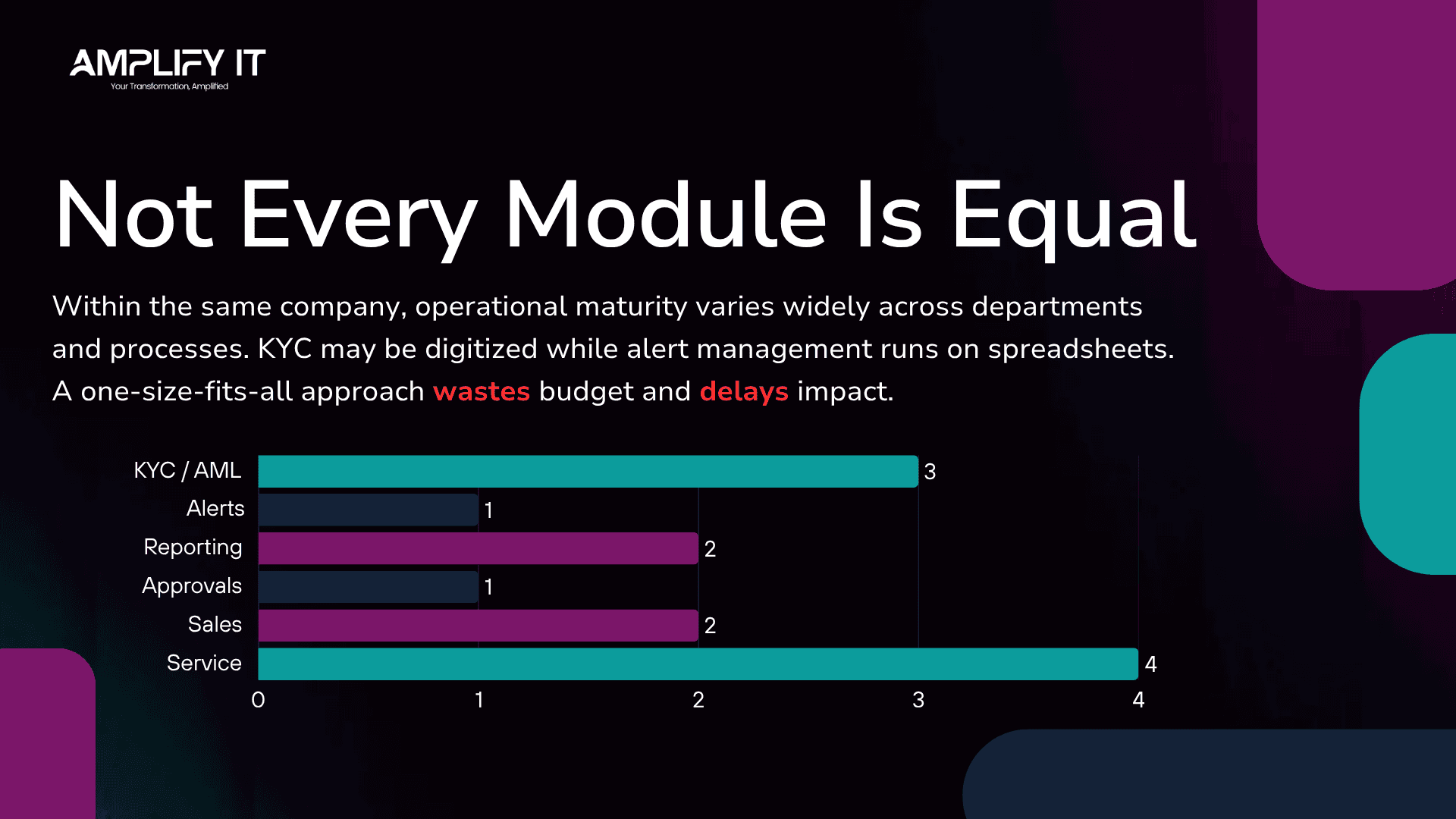
The reality in every mid-market BeLux company is that internal modules operate at very different levels of maturity. Some teams have spent years building rigorous documented processes. Others are still copy-pasting from Excel into Word. Some have dashboards. Others have processes that live in someone's inbox.
A single company-wide score averages all of this into a number that is neither true nor actionable. It tells you nothing about where to spend your next euro.
The AMPLIFY IT Maturity Framework is built differently. Not as a company-level rating. As a module-level diagnostic. This article explains why, and how to use it.
Why module-level
The leadership conversation that goes wrong with company-wide maturity scores usually sounds like this. The CEO believes the company is at Level 3 because of the parts of the business they see. The operations director knows several modules are still at Level 1 because they live with them daily. Both are correct. The company score is a fiction that hides both truths.
The module-level approach asks a different question. Not where this company is on the maturity ladder. Where each module is, and what would advance it to the next rung.
That question has actionable answers. The company-wide score does not.
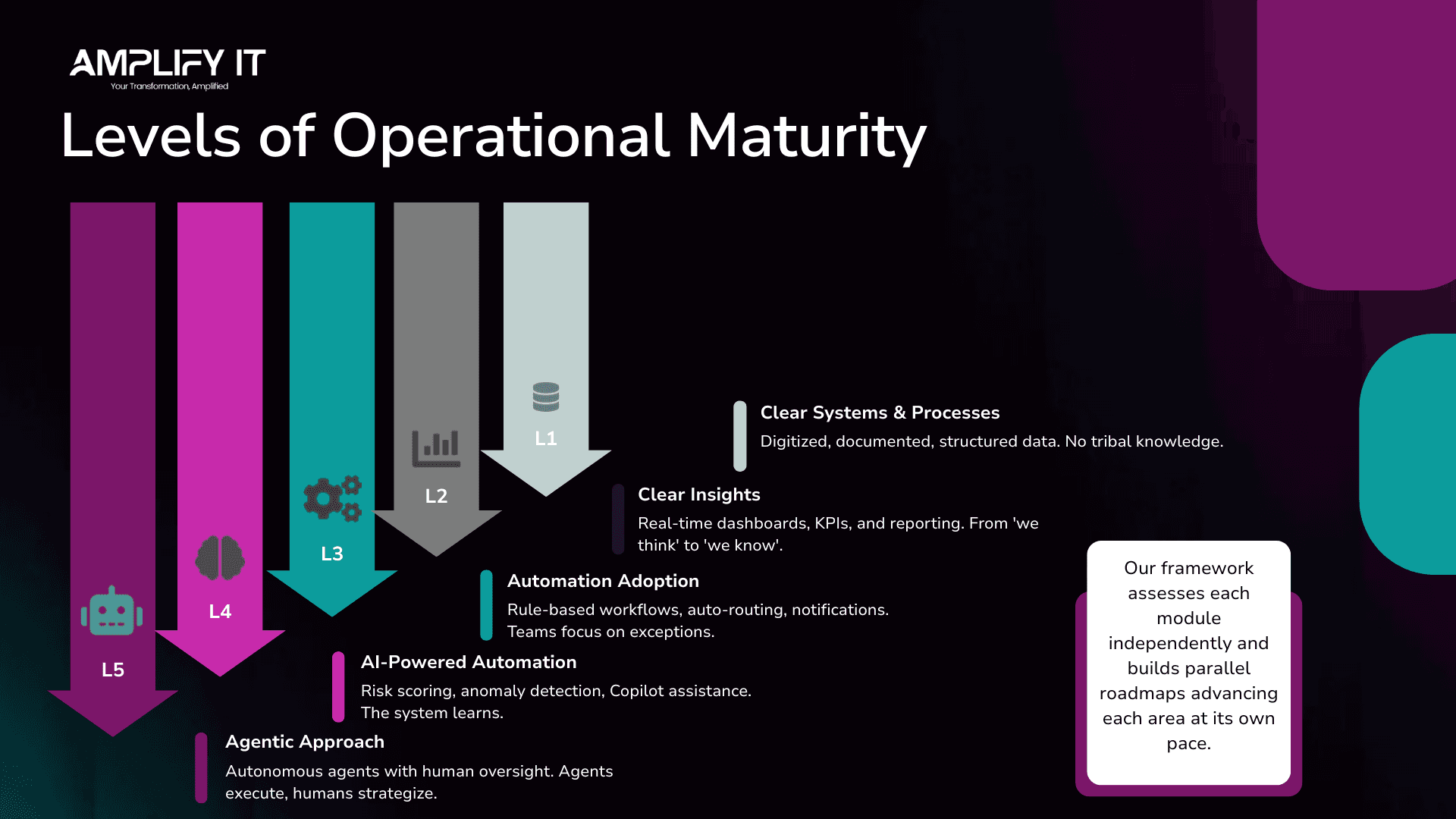
Level 1: Clear Systems and Processes
The data has a home. The steps are written down. Someone owns this module. Nothing more.
Example. An onboarding team where every new-customer file lives in the dedicated system, the steps of onboarding are visible in the system, and a named person is the accountable owner.
Most BeLux mid-market companies have several modules that are not even at Level 1. They have one of the three (system, steps, owner) but not all three. That is the most common starting point.
Level 2: Connected Tools
Information flows between systems. No more copy-paste.
Example. When a new customer is approved in the CRM, their record automatically flows to the document management system, the operational reporting tool, and the email automation platform. Nobody is exporting an Excel and uploading it elsewhere.
This level is unsexy and underrated. The savings are immediate. The risk reduction is real. And it does not require AI.
Level 3: Visible Performance
You can answer 'how are we doing on this module' in real time, without asking anyone.
Example. A dashboard that shows the number of cases in process, the average time to resolution, the bottleneck stage, the case load per team member, the deadlines coming up.
Most companies think they are at Level 3 because they have a dashboard somewhere. The test is whether the dashboard is trusted, up to date, and actually used in operational decisions. Often it is not.
Level 4: Assisted Intelligence
AI helps people make faster, better decisions inside the module.
Example. A Copilot agent that drafts the response based on the case file, surfaces similar past decisions, and highlights risk factors. The human still decides. The human still approves. The AI compresses the time-to-decision and reduces the cognitive load.
This is where Copilot, Copilot Studio agents, and Power Platform AI features start to earn their place. It requires Levels 1, 2, and 3 underneath it. Without them, the AI is guessing.
Level 5: Agentic
AI takes structured actions inside guardrails, with human review at defined checkpoints.
Example. An agent that processes incoming requests, classifies them by impact, drafts the internal response, and routes it to the human owner for approval. The agent does the first pass autonomously. Human approves before anything goes external.
Level 5 is a horizon, not a product. Almost no BeLux mid-market company has any module at Level 5 today. The companies that will get there in 2026 and 2027 are the ones building Level 4 capabilities with the right guardrails right now.
The parallel workstream principle
Here is the operational insight that most maturity models miss. You do not advance a company from Level 1 to Level 5. You advance individual modules, in parallel, at different speeds.
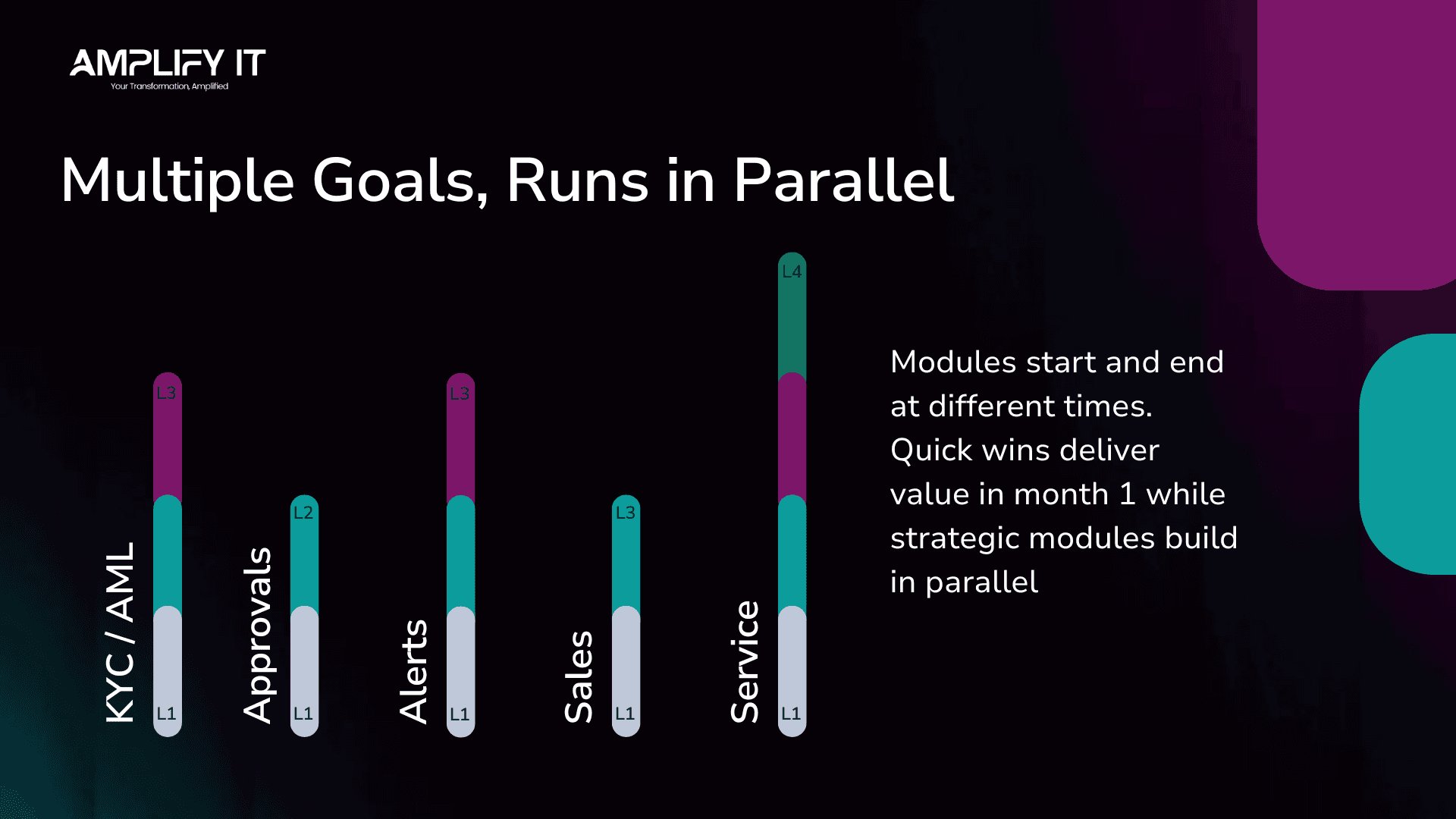
A realistic module map in a mid-market company looks something like this. Customer onboarding at Level 3, ready for Level 4 work. Compliance and audit workflows at Level 1, needing foundation. Operational reporting at Level 2, ready for Level 3. Service-desk at Level 1, needing foundation. Procurement approvals at Level 3, ready for Level 4.
Each module gets its own roadmap. Some get AI investments immediately. Others get foundation work. By end of year, every module has moved up at least one rung, and several have AI in production.
If you try to 'raise the company from Level 1 to Level 4,' the project becomes incoherent. Module-level planning makes it executable.
How to assess your company's level
A self-assessment, runnable on any module in your company, in under ten minutes.
For the module, answer four questions. Where does the master data live. How does information flow between systems. How do you know how this module is performing right now. What does AI do in this module today.
Run this on five different modules in your company. The picture you get will look nothing like your company-wide self-image. That is the point. That is the picture that lets you plan.
The companies that get the most out of the maturity framework are not the ones with the highest scores. They are the ones with the most accurate scores. Honest self-assessment beats optimistic self-assessment every time, because honest tells you where to invest next.
AMPLIFY IT helps Mid-Market companies in Belgium and Luxembourg identify, prioritize, and deliver high-impact workflow automation on Microsoft Dynamics 365 and Power Platform, starting with the workflow that funds the rest.